
Can a Skid Steer Replace a Forklift for Material Handling?
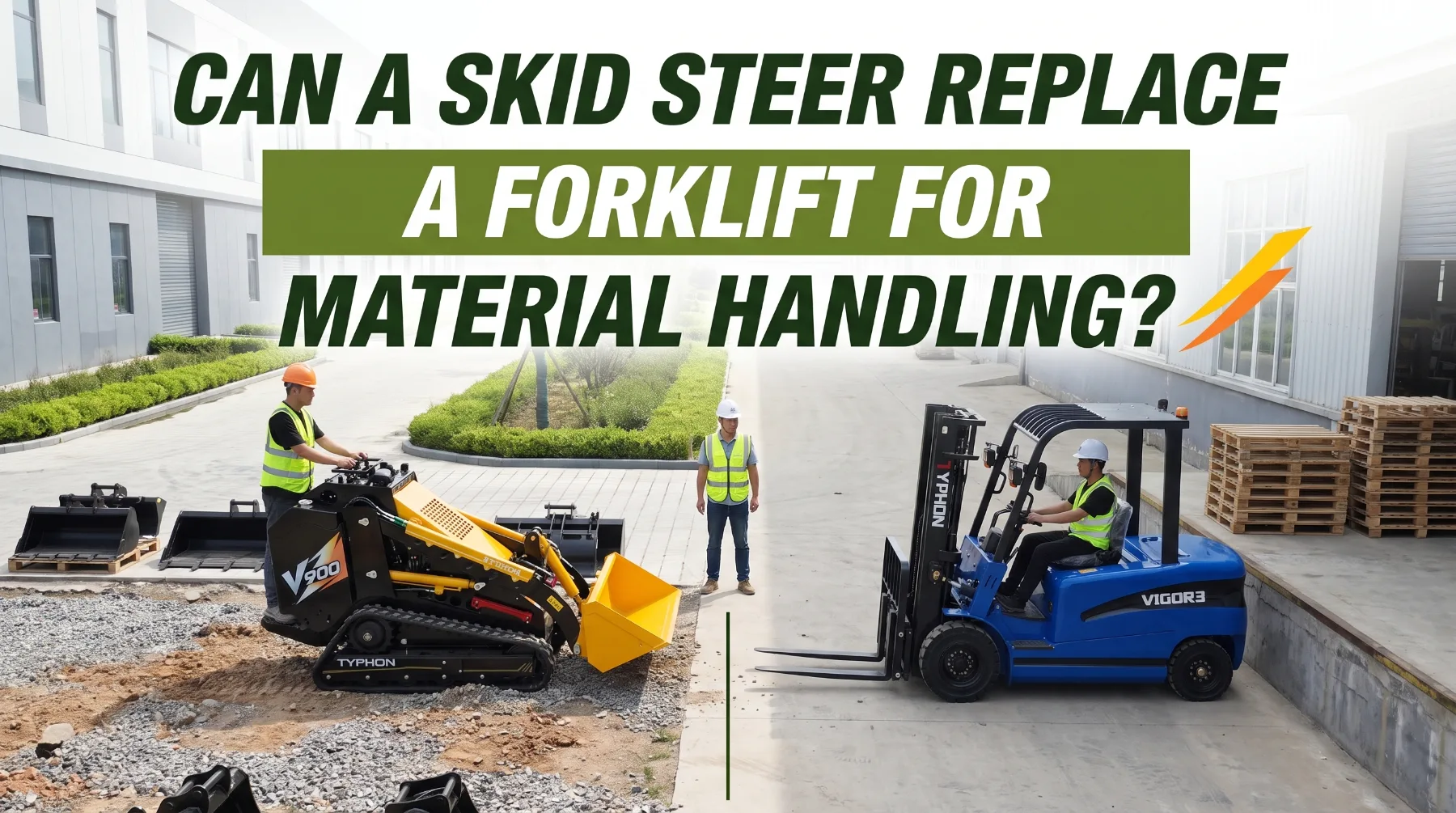
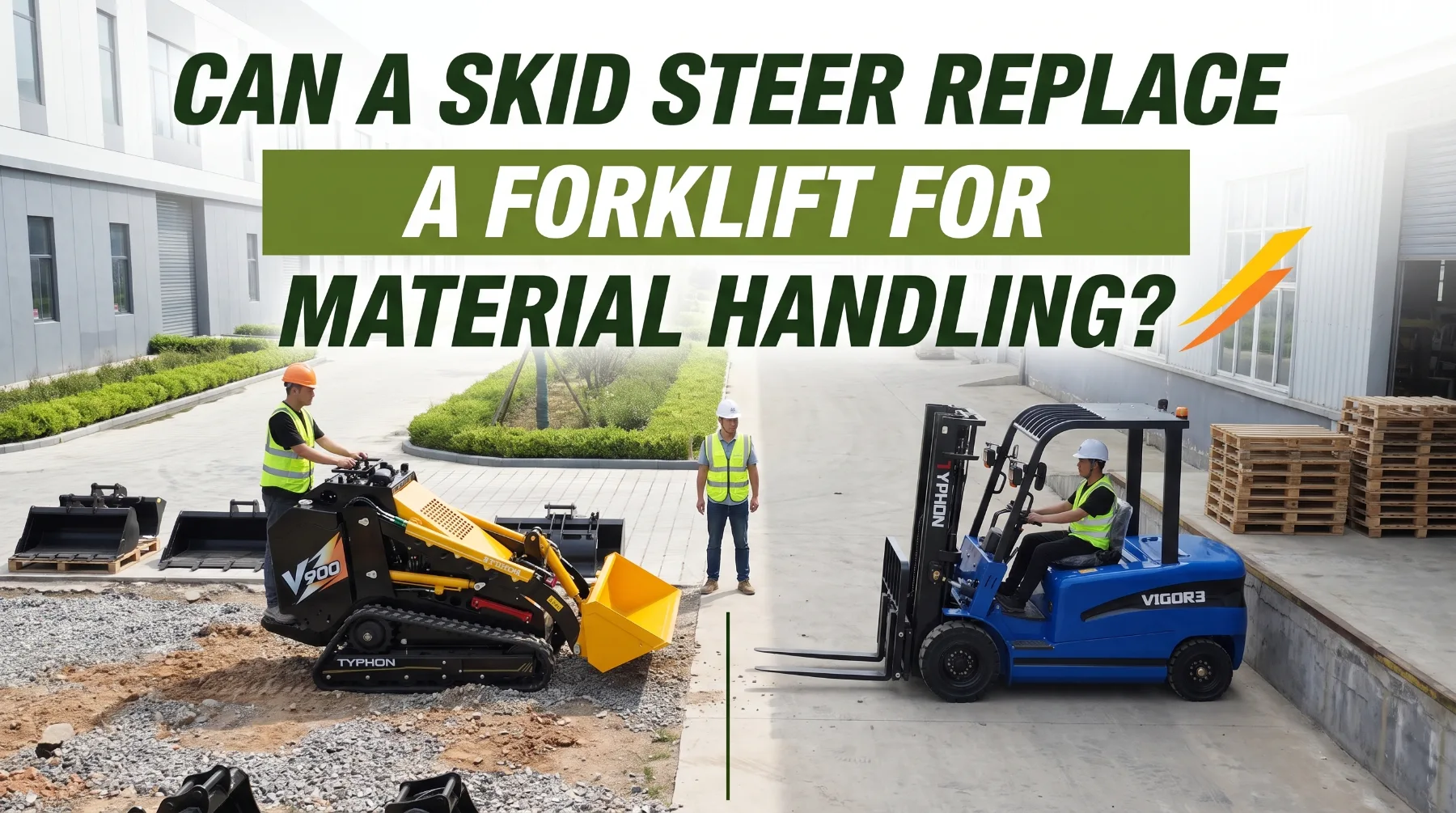
A skid steer and a forklift can both move palletized loads when equipped with forks, but their load-handling capabilities are based on very different machine designs. A skid steer uses a front-mounted attachment system, compact wheelbase, and high hydraulic power to handle a wide range of tools, while a forklift is specifically engineered around load lifting, mast travel, and controlled vertical placement. The forklift’s counterweight, mast geometry, load center, steering system, and rated capacity are designed to keep the machine stable while raising loads to specific heights. A skid steer with pallet forks can provide strong lifting and pushing performance, but its capacity, forward visibility, load center, and stability characteristics change significantly as the load is raised or extended in front of the machine. The choice therefore depends on how the material must be moved rather than whether both machines can physically carry forks. A skid steer can be effective for loading pallets from the ground, moving materials across uneven construction surfaces, and handling applications where attachment versatility is more important than precise high-level placement. A forklift is generally better suited to warehouse aisles, high rack storage, long fork reach, repeated pallet handling, and applications requiring predictable lifting capacity at height. Ground conditions, required lift height, load center, travel distance, maneuverability, visibility, rated capacity, and frequency of pallet handling all influence the decision. Using a skid steer as a substitute makes sense when its operating envelope matches the task, but a dedicated forklift is the more appropriate machine when the work depends on controlled vertical lifting and sustained material-handling cycles.
The Core Design Differences
A skid steer and a forklift look like they should compete, but they’re engineered for opposite priorities. Understanding that split is the foundation for every decision that follows. A skid steer is a compact, highly maneuverable machine built around versatility. Its defining feature is the universal quick attach coupler, which lets one machine run dozens of tools, buckets, grapples, augers, brooms, and yes, pallet forks. It steers by driving its left and right wheels or tracks at different speeds, giving it a tight turning radius and the ability to work in confined spaces. It’s built to dig, push, carry, and load across rough, unimproved ground. A forklift is a purpose built lifting and stacking machine. Its vertical mast raises loads high and places them precisely, and its counterweight is engineered specifically to balance rated loads out on the forks. Most warehouse forklifts run on smooth tires suited to finished floors, though rough terrain models exist for outdoor sites. Where the skid steer spreads its talent across many tasks, the forklift concentrates everything on moving palletized loads quickly, accurately, and to real height. Key takeaway: A skid steer is a versatile, all terrain tool carrier, while a forklift is a specialized machine optimized for lifting, stacking, and precise pallet handling.
Where a Skid Steer Excels at Material Handling
For material handling that reaches beyond flat, finished floors, a skid steer brings real advantages a standard forklift can’t match. Its biggest strength is versatility through attachments. Swap the forks for a bucket, grapple, or broom in seconds, and the same machine moves pallets one hour and loads loose material or clears debris the next. On a mixed job site, that flexibility can genuinely replace several single purpose machines. The second advantage is rough terrain capability. Skid steers, especially compact track loaders, handle mud, gravel, dirt, and uneven ground with confidence. A construction site, landscaping yard, or farm rarely offers the smooth surface a warehouse forklift needs, and this is where the skid steer thrives while a standard forklift would struggle or bog down. The third is maneuverability in tight spaces. The skid steer design turns within its own footprint, so it works in confined areas where a longer machine can’t. On a crowded site with limited room to position, that agility keeps material moving. Key takeaway: A skid steer excels where material handling meets versatility, rough terrain, and tight quarters, conditions that defeat a standard forklift.
Where a Forklift Outperforms a Skid Steer
Put the work on a finished floor with palletized loads, and the forklift pulls clearly ahead. It was designed for exactly this, and that focus shows. The clearest edge is lift height. A forklift mast raises loads far higher than a skid steer’s lift arms, reaching upper racking and stacking loads several levels high. A skid steer’s lift geometry tops out well below that, so any operation that stacks vertically needs the forklift. The second is precision and pallet handling speed. A forklift’s mast tilts, and many carriages side shift, letting an operator slide a pallet into a rack slot cleanly and repeatedly. Combined with fast lift and travel speeds on smooth floors, this makes the forklift far quicker at high cycle pallet work, the hundreds of repetitive lifts a busy warehouse runs every shift. The third is indoor operation. Electric forklifts run clean and quiet with zero emissions, purpose built for enclosed spaces. They also see over and around loads better in tight aisles, and their stability out on the forks is engineered for exactly the loads they carry. For sustained indoor warehouse work, nothing about a skid steer competes. Key takeaway: A forklift outperforms a skid steer on lift height, pallet precision and speed, and clean, efficient indoor warehouse work.
The Factors That Decide Which Machine Fits
Choosing between the two comes down to an honest read of your actual work. Four factors settle most decisions.
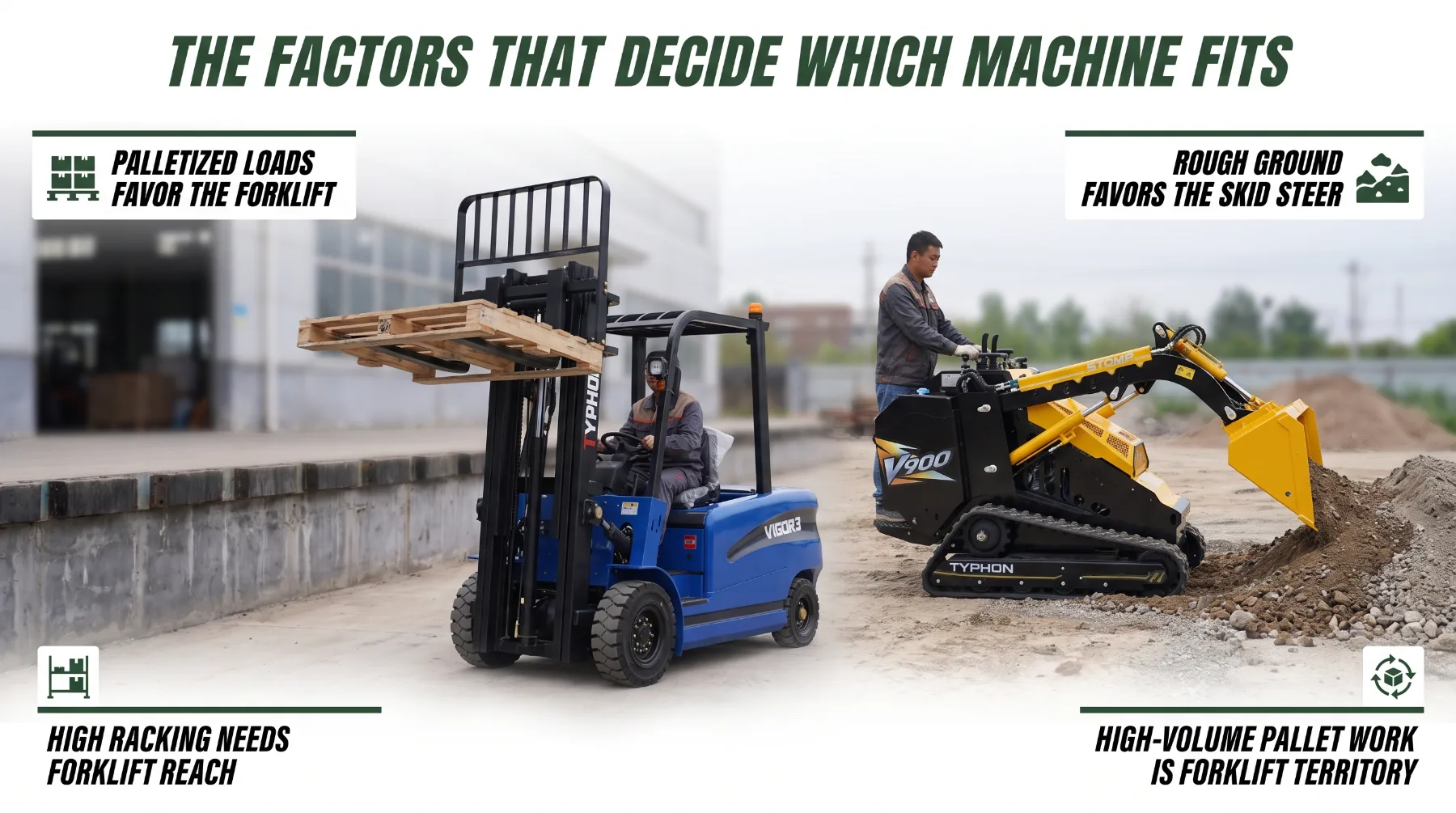
- Load type. Palletized, uniform loads stacked in racks favor the forklift. Loose material, mixed debris, or loads that change from task to task favor the skid steer’s swappable attachments.
- Site conditions. Smooth, finished floors point to a forklift. Rough, muddy, or uneven outdoor ground points to a skid steer or a rough terrain machine built for it.
- Lift height. If you need to stack high or reach upper racking, only the forklift’s mast delivers. If most lifts are low, ground to truck bed, or onto a low platform, the skid steer’s range is often enough.
- Duty cycle. High volume, repetitive pallet handling all shift long is forklift territory, where its speed and precision pay off cycle after cycle. Intermittent, varied handling mixed with other tasks suits the skid steer’s flexibility.
Weigh these together rather than in isolation. A machine that wins on one factor but loses on the other three is usually the wrong call. Key takeaway: Load type, site conditions, lift height, and duty cycle together decide the right machine, judge them as a set, not one at a time.
When a Skid Steer With Forks Can Substitute for a Forklift
There are real scenarios where a skid steer running pallet fork reasonably stands in for a forklift, and recognizing them can save the cost of a second machine. The best fit is occasional, low lift handling on a job site you already work with a skid steer. If a contractor needs to move pallets of blocks, bags, or supplies off a delivery truck and set them on the ground a few times a day, forks on the skid steer already on site do the job without a dedicated forklift. It also works well on rough outdoor ground where a standard forklift can’t operate. Moving palletized material across a muddy or uneven site plays directly to the skid steer’s strengths, and its low height lifting is enough for ground level placement. And it makes sense when versatility outranks specialization. An operation that handles pallets only now and then, but digs, grades, and loads constantly, is often better served by one skid steer with forks than by owning a forklift that sits idle most of the week. Key takeaway: A skid steer with forks substitutes well for occasional, low lift, ground level pallet work, especially on rough sites where a standard forklift can’t go.
When a Skid Steer Simply Cannot Replace a Forklift
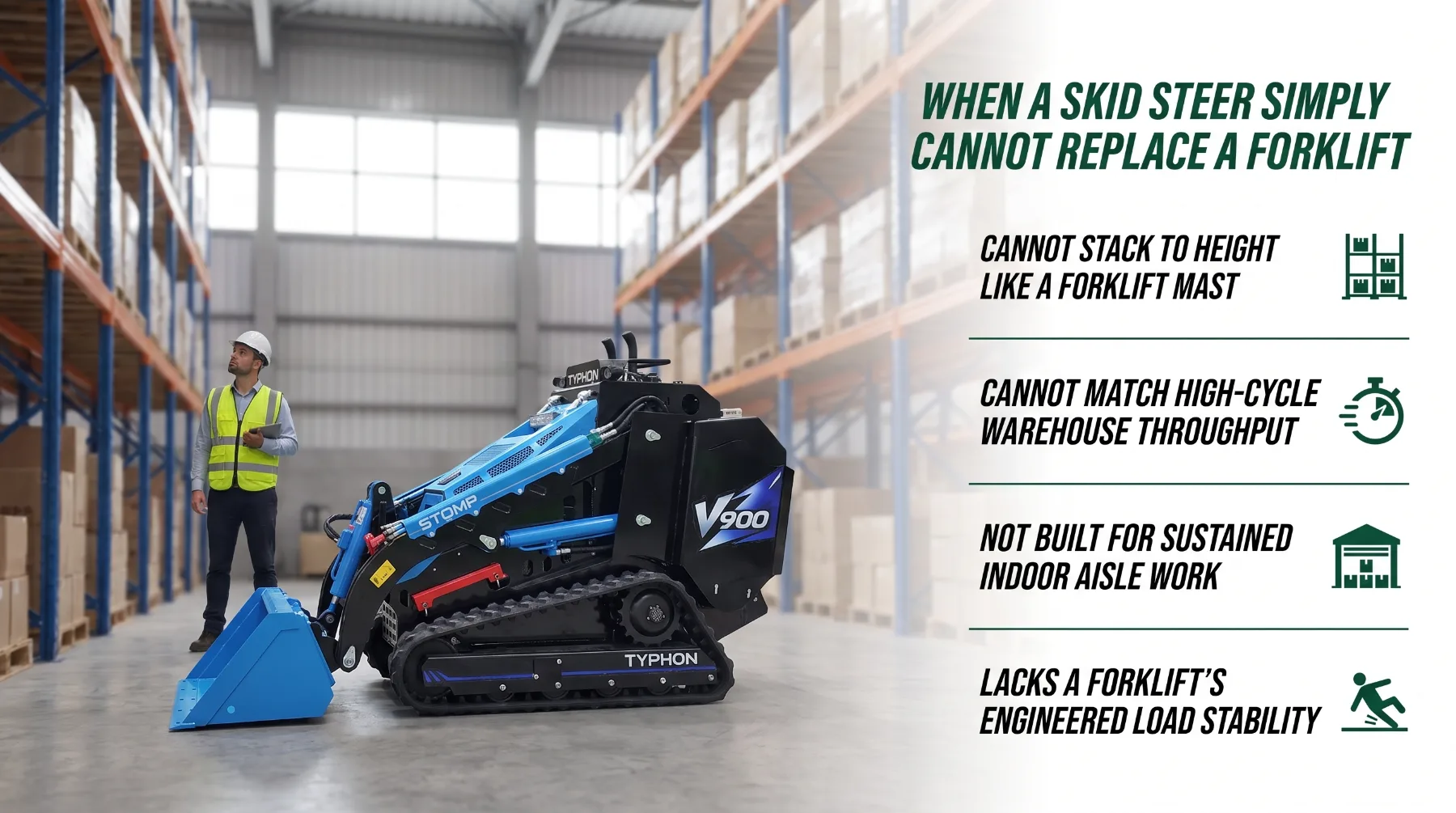
Just as important is knowing the limits, because forcing a skid steer into forklift work is slow, inefficient, and unsafe. It cannot stack to height. Any operation that loads upper racking or stacks pallets several levels high needs a forklift mast, the skid steer’s lift arms don’t reach full stop. It cannot match high cycle warehouse throughput. For hundreds of precise pallet placements a shift, a skid steer is far slower and less accurate. It lacks the mast tilt, side shift, and sustained speed that make a forklift efficient, so productivity falls sharply. It isn’t the right tool for sustained indoor work. A diesel skid steer can’t run enclosed for emissions reasons, and even where an option exists, the machine’s size, visibility, and handling aren’t suited to tight warehouse aisles the way a forklift is. And critically, it doesn’t offer a forklift’s engineered load stability. A forklift’s counterweight and geometry are designed around lifting rated loads on forks. Pushing a skid steer beyond its lower, differently balanced lifting limits invites a serious tip or load drop hazard. Stay within the machine’s rated capacity, always. Key takeaway: A skid steer can’t replace a forklift for high stacking, high cycle warehouse work, sustained indoor use, or the engineered load stability that heavy pallet lifting demands.
Conclusion
A skid steer equipped with pallet forks can perform certain material-handling tasks, but its ability to substitute for a forklift depends on load characteristics, lift height, terrain, stability requirements, and duty cycle. A skid steer is primarily designed as a versatile tool carrier, with high tractive effort, compact dimensions, and the ability to operate attachments across rough or uneven ground, while a forklift is specifically engineered for pallet handling, controlled lifting, stacking, and repeated material movement. Skid steers can be effective for occasional low-level pallet handling on construction sites, agricultural properties, and other rough-terrain applications where attachment versatility and ground clearance are important. Forklifts generally provide greater lift height, more precise load positioning, purpose-designed mast and carriage systems, and better efficiency for repetitive pallet movement, particularly on prepared indoor surfaces. Load stability is also a critical consideration because a skid steer with forks must remain within the manufacturer’s rated operating capacity, tipping-load limits, attachment specifications, and approved load-center requirements, while changes in boom position and load elevation can significantly affect machine stability. High stacking, elevated pallet placement, continuous warehouse cycles, and applications requiring precise load positioning are therefore better suited to a forklift designed for those conditions. Machine selection should consider payload mass, load center, required lift height, travel distance, surface conditions, grade, visibility, operating space, attachment configuration, and expected cycle frequency. A skid steer with forks can provide a practical alternative when pallet handling is secondary to general-purpose work and loads remain within the machine’s rated limits, but replacing a forklift for sustained high-cycle or high-elevation material handling can reduce productivity and introduce inappropriate stability and load-handling characteristics. The correct choice should be based on the most demanding realistic material-handling task rather than attachment compatibility alone.
Frequently Asked Questions
Can I just put pallet forks on my skid steer instead of buying a forklift? Often, yes, for occasional pallet handling. A skid steer with forks works well for low lifts and rough outdoor ground, especially when the machine is already on site. However, it cannot match a forklift for high stacking, repetitive pallet handling, or engineered load stability. If pallet work is frequent, precise, or involves upper racking, a forklift is the better choice. Which machine is better for a warehouse? For regular indoor warehouse work, a forklift is the better fit. It is designed for high stacking, precise pallet placement, and fast repetitive cycles. Electric forklifts also operate quietly and without exhaust emissions, making them well suited to enclosed spaces and tight aisles. A skid steer generally lifts lower, moves pallets less efficiently, and diesel models are unsuitable for indoor operation. What’s the single biggest factor in choosing between them? Lift height is often the quickest deciding factor. If you need to stack pallets high or reach upper racking, a forklift’s mast is essential. For low-level lifting on rough ground with varied tasks, a skid steer offers more versatility. For finished floors and high-volume pallet handling, a forklift is more efficient. Start with your highest routine lift, then consider load type, site conditions, and duty cycle.